The Room Wasn’t Wrong, It Just Needed Editing.
How paint, proportion, and a few thoughtful changes transformed our family room-without erasing what made it ours.
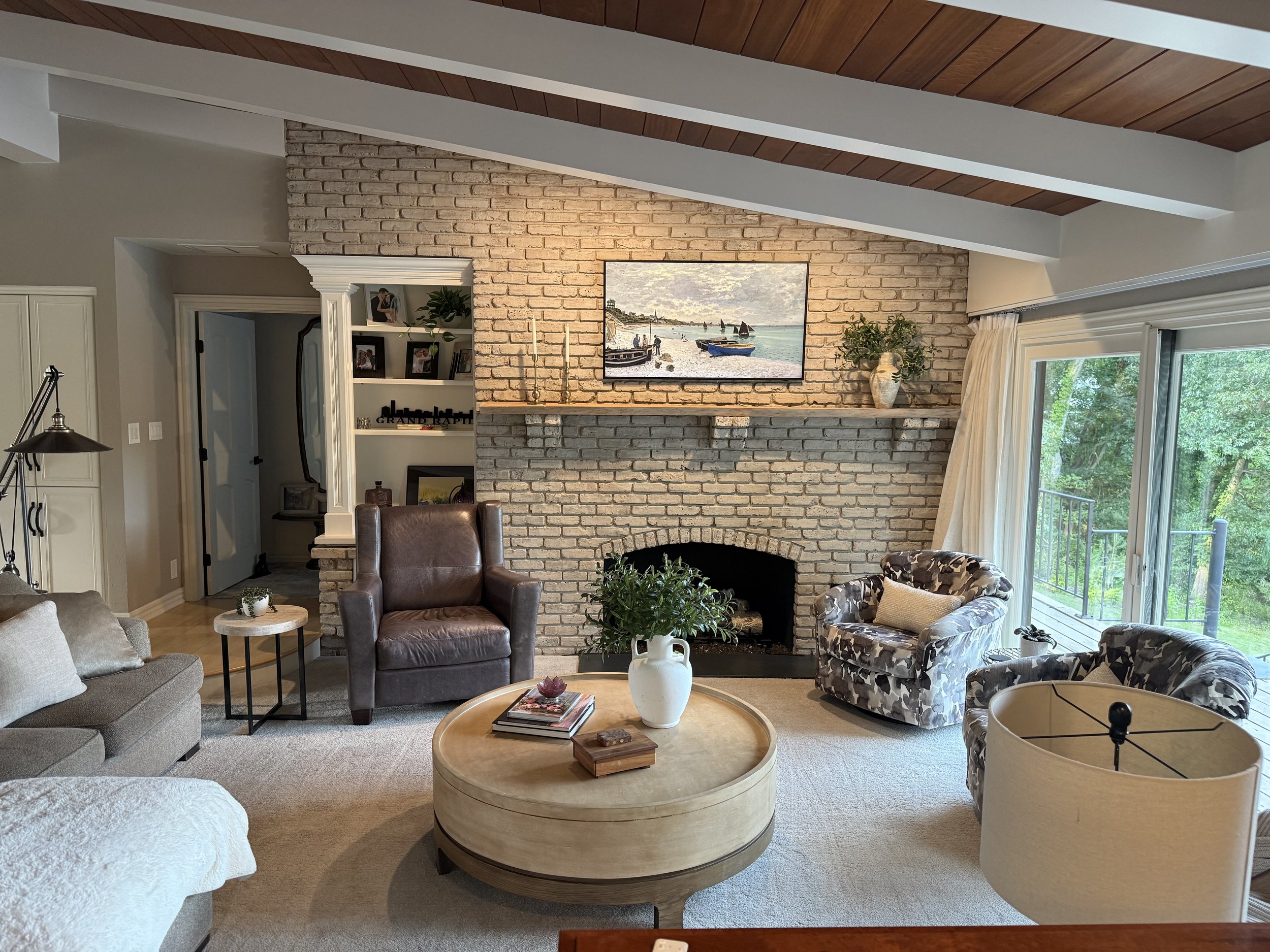
(Room After)
There was nothing truly wrong with our family room.
It had many of the things I love most about our home: a warm wood ceiling, strong white beams, a wall of brick, and wide doors opening toward the lake. It was comfortable. It was used. It held family conversations, quiet mornings, basketball and football games, dogs, grandchildren, parties, and ordinary evenings at home.
And yet, something about it never felt quite resolved.
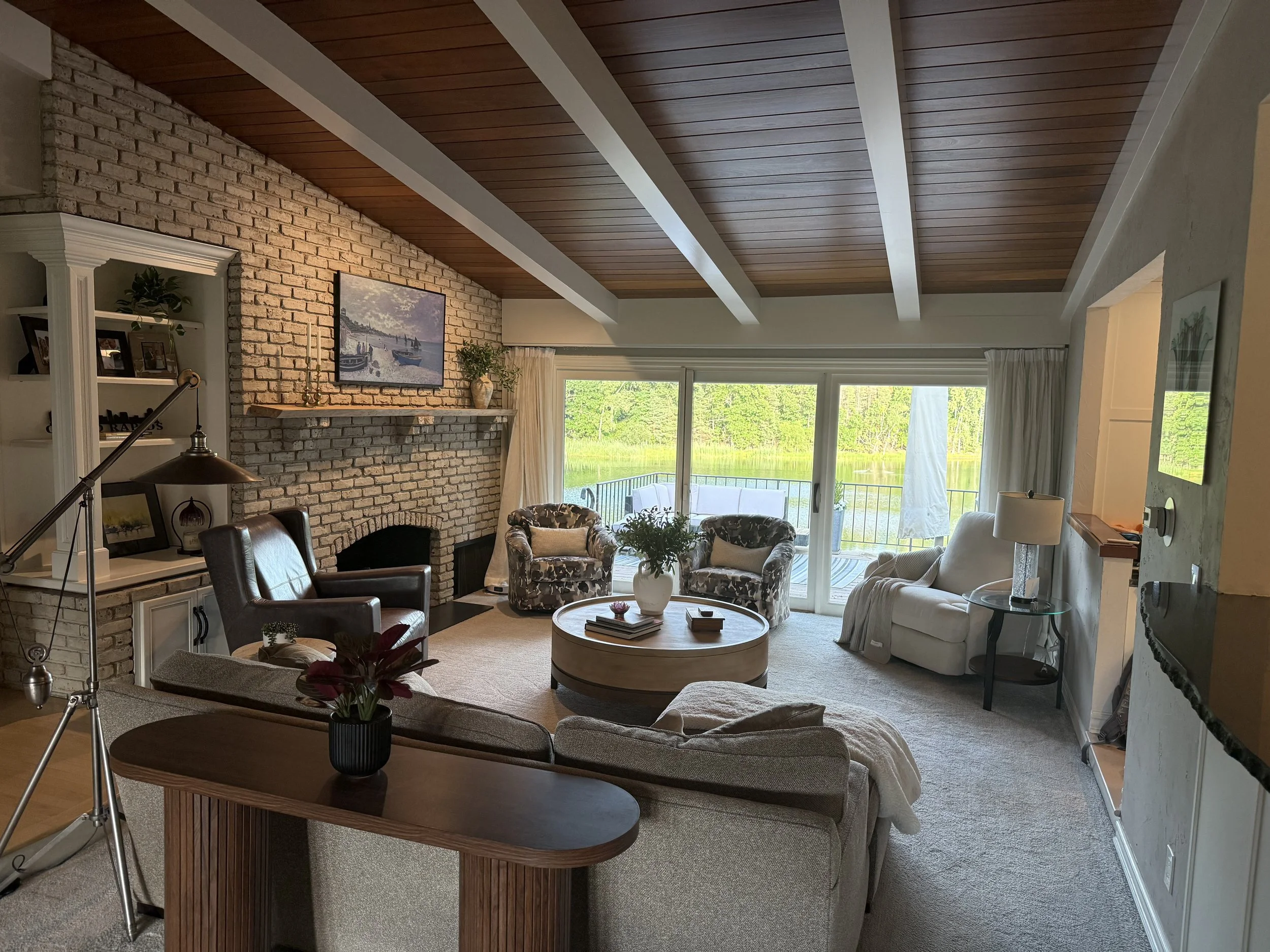
(Room After)
For a long time, I assumed the answer was to add something-to find another accessory, another piece of furniture, or some elusive finishing touch that would finally pull the room together.
Eventually, I realized the room did not need more.
It needed editing.
Seeing the Room Differently
The fireplace wall was the natural focal point, but the original brick carried so much visual weight that it competed with everything around it. Instead of grounding the room, it made the entire space feel heavier.
Painting the brick was the first significant change.
I hesitated for 7 years. Brick feels permanent and painting it can inspire surprisingly strong opinions. But preserving something simply because it has always been there is not the same as honoring it. I wanted the brick to still show some of the original variegation so I chose a limescale wash instead of a solid paint.
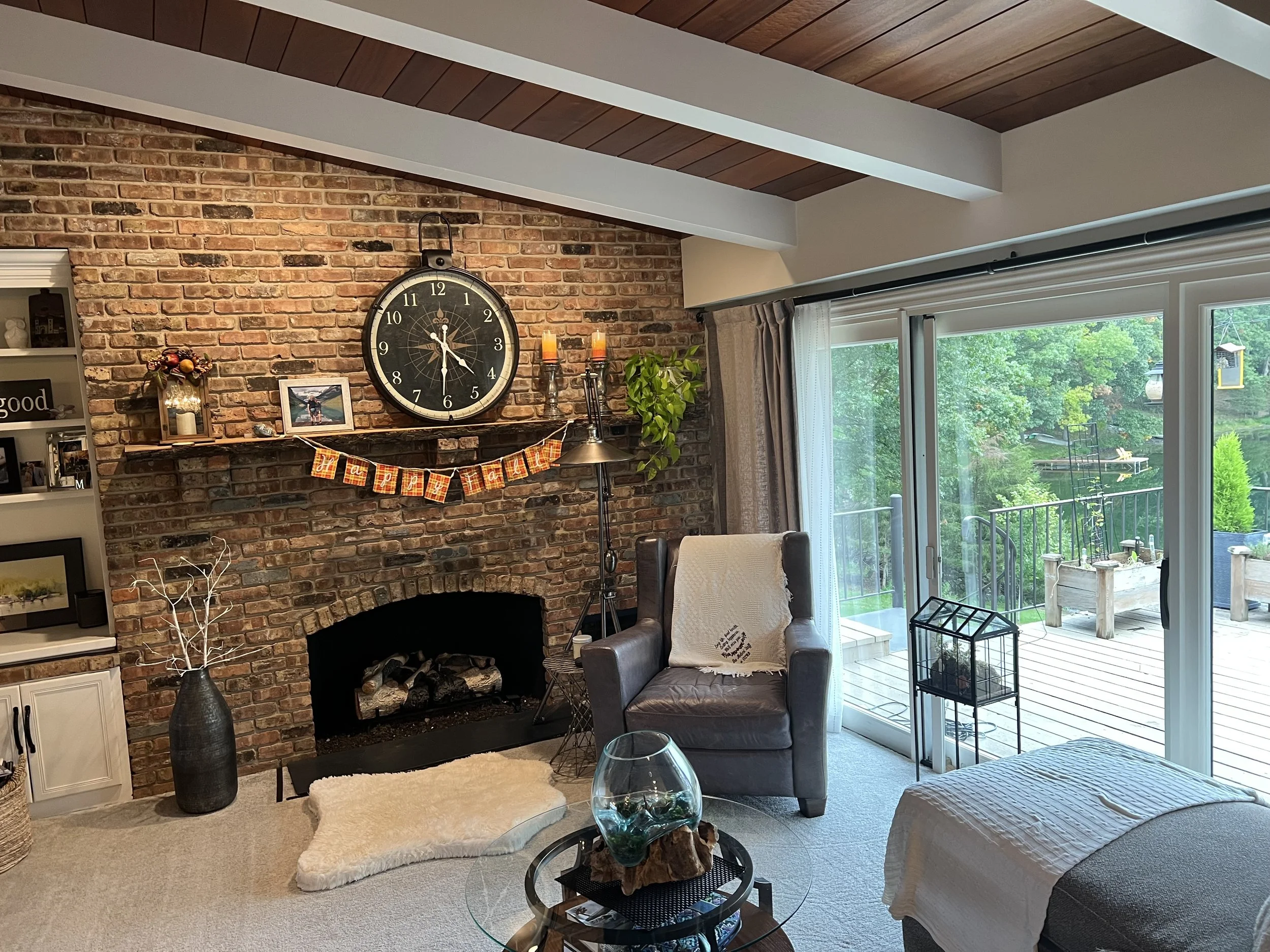
(Family Room before)
Once the brick was softened, I could finally appreciate the fireplace itself, and the beautiful ceiling we had installed above it years ago. The room felt lighter without losing its warmth or architectural character.
That one decision changed the way I saw everything else.
Rearranging Before Replacing
The next change cost nothing.
I reconsidered the furniture arrangement.
Over time, pieces had settled into places that were individually practical but did not create a cohesive room. The seating did not relate to the fireplace, the view, and one another as well as it could.
By bringing the furniture into a more intentional conversation area, the room began to feel welcoming rather than merely furnished.
The patterned swivel chairs can still turn toward the lake, but they also became apart of the room. The sofa helped define the seating area. The leather chair added warmth and contrast. Even the recliner-chosen for comfort for my surgical recoveries rather than design drama felt more connected once the other pieces had a clearer relationship to one another.
It reminded me of something easy to forget when decorating: before deciding that we need new furniture, it is worth asking whether the furniture we already own is simply standing in the wrong place.
The Coffee Table Problem
The room still needed an anchor.
For a large space, the coffee table had to be substantial enough to hold its own without making the seating feel crowded. That balance was much harder than I expected.
I looked at tables that were beautiful but too small, others that appeared too yellow or too red, and some that seemed promising until I read the reviews. I wanted something with a designer presence, but I did not want to buy an expensive table merely because I was tired of looking.
Scale was more important than trend.
The round table I ultimately chose was large enough to connect the seating without visually interrupting the room. Its lighter wood brought warmth while remaining distinct from the darker console behind the sofa and the rich wood ceiling overhead.
As a blessing, the same day I find the table online, it was listed for sale on Facebook marketplace two hours away for a third of the cost making it worth the drive to pick it up.
Once I picked it up and placed it in the room, the room finally felt grounded.
The table did not demand attention. It created order.
Keeping What Matters
Editing a room does not mean removing everything personal until it resembles a showroom.
Quite the opposite.
One of the objects on our coffee table is a wooden box made by my son in school as a young boy. It may not have been selected. by a designer, but no decorative object could carry more meaning for me.
It belongs there.
The box adds a deeper kind of beauty, one rooted in memory, love, and the hands that made it for me. It also reminds me that a thoughtfully designed home should still reveal the people who live there.
The patterned chairs remained because they bring energy and personality. Cream pillows softened them without disguising them. Family photographs stayed on the shelves. Objects were removed from the mantel and the mantle restrained so the architecture could remain the focus.
The goal was never to strip the room of its history.
It was to let the things that mattered have enough space to be seen.
Knowing When to Stop
Perhaps the hardest part of decorating is recognizing when a room is finished.
There is always another vase, pillow, lamp, or decorative object waiting to convince us that it might be the missing piece. Sometimes it is. More often, it is not.
Once the fireplace was softened, the furniture rearranged, the correctly scaled coffee table added, and the surfaces simplified, the room no longer felt as though it were asking for something.
It feels settled.
Not perfect. Not untouchable. Not staged for a photograph.
Settled.
The room still accommodates real life. Blankets are used. Chairs are chosen for comfort. Family photographs fill the shelves. The dogs pass through. The view changes with the seasons.
But for now, the room feels more like us: warm, elegant, comfortable, and personal.
A Few Lessons From the Room
This transformation reinforced a few ideas I want to remember:
Work with the architecture instead of competing with it.
Rearrange before replacing.
Correct the scale of the largest pieces before adding accessories.
Keep the objects that carry meaning.
Allow empty space to be part of the design.
Look at what you already own before purchasing something new.
Stop when the room feels resolved.
Sometimes a room does not need to become something entirely different.
It needs us to see clearly what is already beautiful, release what is not working, and make a few confident edits.
The room was never wrong.
I simply needed to listen to what it was asking for.
What about your own rooms? Have you ever discovered that a space needed less that you thought-perhaps just a new arrangement, a fresh perspective, or a few things from elsewhere in your home? I would love to hear what you have edited, rearranged, or rediscovered.